

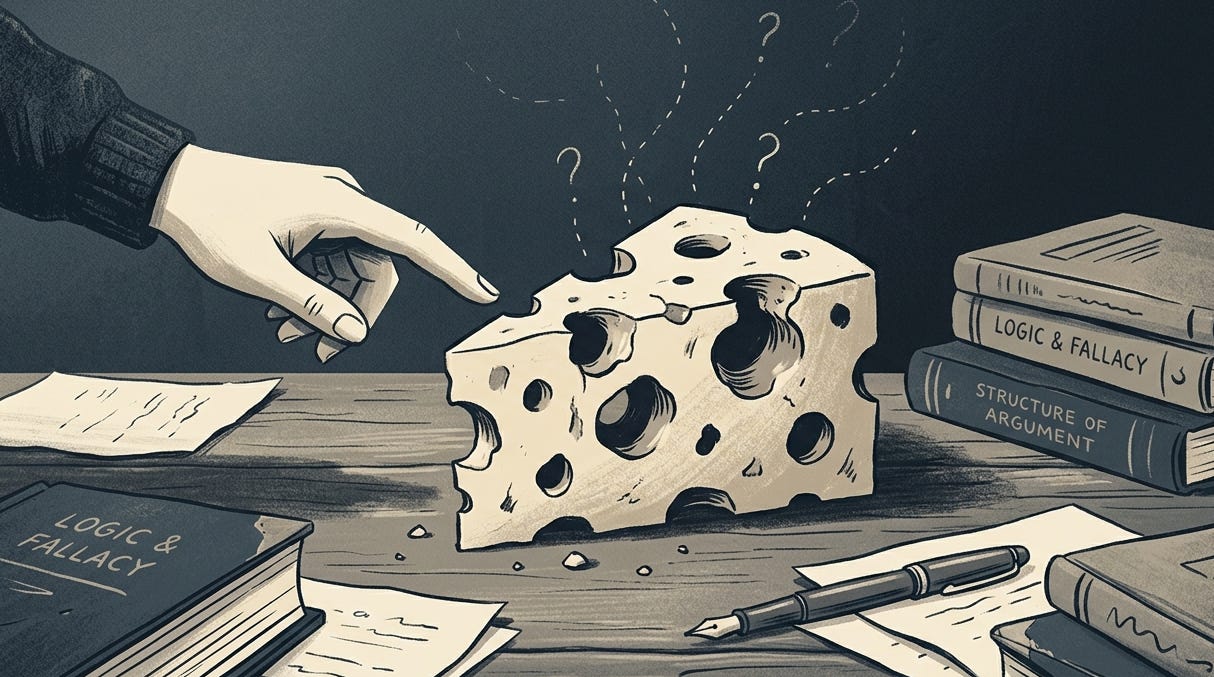
The problem of evil is usually proposed as the strongest argument against God’s existence. I, myself, also believed this was the sharpest arrow in the atheist’s quiver, but after writing this, I’m doubtful at best. The version of the problem of evil most people hear goes something like this: If an all-powerful, all-loving God exists, why is there suffering? An all-powerful God could prevent it. An all-good God would want to prevent it. So either God isn’t all-powerful, isn’t all-good, or doesn’t exist…
If I may, let me propose a metaphysical (I defined tricky terms at the bottom of the article, so just scroll down there if you need help… no shame here) argument. My goal is not to prove the existence of God, but to at least eliminate the idea that if evil exists then God isn’t all-powerful or actually just is much less likely to exist at all. Is suffering a requirement for a conscious world to exist? Whether you’re a theist or an atheist, I think it’s important to always give both sides a chance in order to hopefully find truths and not just confirm your own biases. But as always, I’ll try my best to be Switzerland here.
Fair enough? Let’s begin!
The Burden of Proof
The first hole is the burden of proof. The atheist usually frames the problem as a series of questions for the theist:
Why would a perfect God allow suffering?
If God is all-powerful, why didn’t He create a world without suffering?
If God is all-loving, why does He permit evil and suffering?
If God could intervene at any moment, why doesn’t He stop the suffering?
These are serious questions, and they deserve serious answers. They’ve moved more people toward atheism than perhaps any other argument in the history of philosophy. I want to give the questions their full weight before responding.
But notice what every version of these questions assumes: that a conscious world without suffering is possible, and that God should have made such a world.
The atheist never defends this assumption. They treat the assumption as obvious. Of course a world without suffering is possible. Of course God could have made one. The entire force of the argument depends on this being true. I don’t think it is… And I think the atheist needs to defend the assumption before the “problem of evil” question can do the work they want it to do.
The move for the theist is to turn the question back on the atheists and use their own strongest argument against them. The burden of proof is not only on the theist to make sense of the problem of evil, but also on the atheist to explain to the theist the world, with no suffering, that they are envisioning.
The atheist owes the theist an answer here. If their argument lives on the assumption that a suffering-free conscious world is possible, the atheist needs to describe such a world. Not a vague gesture toward one, but an actual account.
Can consciousness exist without something to act upon?
I don’t think so. Consciousness, at minimum, is the ability to distinguish. The ability to distinguish requires two or more things to distinguish between. Distinction introduces preference. The moment preference is introduced, there is now a most-preferred thing and a least-preferred thing. The least-preferred thing, by definition, is the most evil thing in existence and is the highest-level of suffering.
How do you define suffering without consciousness? Can something without consciousness suffer? Of course not.
We are no longer asking why God would allow suffering. We are asking what consciousness actually requires in order to exist at all.
The Core Argument
Here is the positive case, built in steps.
First, consciousness requires something to be conscious of. There can be no awareness of nothing.
Second, conscious experience requires preference. Some things must be preferred over others, otherwise consciousness has nothing to act on, nothing to evaluate, nothing to distinguish. A thinking thing that experiences everything as identical is not a thinking thing.
Third, preference requires contrast. To prefer something is to prefer it over something else. This produces a structure: a most-preferred thing and a least-preferred thing, with a range of options between them.
Fourth, the least-preferred thing in any conscious world is, by definition, the greatest evil within that world. Not because there is anything inherently bad about that thing, but because preference creates the categories of better and worse.
Suffering is necessary for consciousness. Suffering is fully relative and fully subjective.
A Pure White World Thought Experiment

Imagine a world of only whiteness. All you have ever known is white. You couldn’t even know you were conscious, because you have nothing to compare anything to. But let’s grant, for the sake of the argument, that you somehow do.
In this world of pure white, your consciousness has nothing to act on. There is no preference because there is no contrast. Everything is the same. You can’t choose, evaluate, want, or refuse. You just are, indistinguishably, surrounded by white.
Now introduce black.
If you prefer white over black, black is now the greatest evil in your world. Not because black is inherently bad. Not because black causes physical suffering. But because a preference has been introduced, and black is on the less-preferred side of that preference. Black is the greatest evil you can experience, simply because it’s the only thing other than white, and you prefer white.
Now keep filling in the world. Add color, add more colors. Add shapes. Add complexity. Eventually, you arrive at something like our world, with its enormous range of experiences and its corresponding enormous range of preferred and less-preferred things. Or you arrive at a different world, with a different range, different worst things, different best things. The structure holds regardless. Every conscious world has its greatest good and its greatest evil, with everything else fitting somewhere on the spectrum between them.
God Cannot Make a Square Circle

If God cannot create consciousness without suffering, doesn’t that mean God is not all-powerful? No.
God also has the inability to create a square circle, this does not mean God is not all-powerful. A square circle is not something God refuses to make. A square circle is not a thing at all. The words “square” and “circle” describe properties that exclude each other. The phrase is incoherent.
Consciousness without preference is the same kind of phrase. Consciousness requires preference, and preference creates a range of better (less suffering) and worse (more suffering). To strip preference from consciousness is not to find a purer form of consciousness. It is to find nothing left at all.
So when we ask why God allows suffering, we are not asking why God chose this option from a menu of possibilities. The menu has one item and if you want to eat you have to order. God created consciousness with the only structure consciousness can have.
Preference is fundamental to consciousness. To prefer, by definition, is to experience good and bad. Some degree of suffering must therefore exist in any conscious world. And because suffering is fully relative, every conscious world will have its worst imaginable suffering and its highest imaginable bliss. You’d be asking for existence without the thing that fundamentally makes you aware of your existence.
Objections and Responses
The argument has a few natural objections. Each one needs an answer.
The first objection is about degree. Sure, maybe some suffering is necessary for consciousness. But why this much? Why the Holocaust, why bone cancer in children, why billions of years of animal predation? Doesn’t the sheer intensity of suffering in our world go beyond anything a structural argument can justify?
The response: suffering is fully relative to the worst available thing in any conscious world. There is no absolute scale. Every conscious world has its greatest evil, and that greatest evil is, within that world, the worst thing imaginable. Our world has Earth-level suffering. A different world might have far less. Another might have far more. In each world, the worst thing is the worst thing.
The question “why this much?” assumes an external scale that does not exist.
Here is another way to see it. When would the stripping away of suffering ever be enough? Imagine removing the worst thing from our world. We are left with a new worst thing. Remove that. A new worst thing rises in its place. Keep going.
At some point we arrive at near-nothing. Just a small handful of things left. One of them is still the greatest imaginable suffering. Another is still the greatest imaginable bliss. The structure has not changed. Only the contents.
Strip away further. Eventually only two things remain. One is still the worst. One is still the best.
Strip away one more. Now there is only a single thing. And at that moment, consciousness collapses, because there is no longer anything to distinguish, anything to prefer, anything to be aware of.
There is no version of this exercise that produces a conscious world without suffering. Every stopping point along the way still has a worst-thing within it. The only world without suffering is the world without consciousness. And the world without consciousness is not a world at all.
The question “why this much suffering?” is not a hard question. It is the wrong question. There is no amount of suffering reduction that would ever satisfy the questioner, because no such world exists.
The second objection is about Heaven, or any conception of a perfect afterlife. Don’t most religions describe a state of pure bliss without suffering? If suffering is necessary for consciousness, isn’t this incoherent?
The argument does not depend on any particular view of the afterlife. If Heaven exists and is a state of pure bliss, the contrast required for consciousness could come from memory of Earth. Every being in Heaven would carry the memory of suffering that gave them their preference scale during life. Pure bliss is possible because the worst is remembered, not lived.
A natural follow-up: why couldn’t God have just given us the intrinsic understanding of evil and suffering at birth, allowing us to skip Earth and go straight to Heaven?
Because intrinsic, built-in knowledge of suffering would itself be a form of suffering. If you carried the awareness of evil in your very being from the moment of consciousness, that awareness would be the worst thing in your world. It would be lived suffering, not remembered suffering. The contrast would be built into the fabric of your being rather than sitting safely behind you in memory.
PTSD bears this out. Most of the lasting suffering of trauma comes not from the event itself, but from the awareness it revealed of what evil can do.
The reason Heaven works as pure bliss is precisely because we physically lived through the suffering and now exist in memory of it. We are removed from the suffering, not carrying it in our essence. The lived experience is what allows the eventual removal.
Heaven could also be a kind of consciousness very different from ours, in which case our intuitions about what it would feel like may simply be wrong. The argument here does not require settling that question.
The third objection comes from contemplative traditions. Don’t Buddhist monks, mystics, and certain meditative practitioners describe states of consciousness without preference? Pure awareness, equanimity, the witness state?
The contemplative reporting such a state is doing so from inside the preference-having framework. Memory, language, and imagination are all preference-based. The contemplative’s report is built entirely from tools that depend on the framework they claim to have escaped.
What we have is anecdote, not evidence. The contemplative cannot describe a state of consciousness without preference, because doing so would require referring to something that, by the argument in this essay, does not exist. Something interesting is happening in these states. They are altered modes of preference, not preference-free consciousness.
A Note Toward Meaning
This framework isn’t a justification for cruelty or an instruction to accept suffering passively. We still suffer when we suffer. The pain is real. The losses are real. None of this is dismissed by saying that suffering is structural rather than aberrational.
But the reframing matters. If suffering is the cost of being conscious at all, then suffering is not a defect in existence, not a sign that something has gone wrong, not evidence that the universe is broken or that God is absent or cruel. It is the price of awareness. The same structure that produces the worst experiences produces the best ones. You cannot have joy without the possibility of sorrow, fulfillment without the possibility of disappointment, love without the possibility of loss. The same range that makes the worst possible also makes everything else possible.
For the theist, this dissolves a major objection without requiring any specific apologetic move. For the atheist or agnostic, it offers a perspective in which suffering is not absurd, not meaningless, not a cosmic accident. It is structurally tied to the awareness that makes any experience possible.
In a Nutshell
The problem of evil assumes a conscious world without suffering is possible. It isn’t.
Consciousness requires preference. To be conscious is to distinguish one thing from another, and to distinguish is to prefer. The moment preference exists, there is a most-preferred thing and a least-preferred thing. That least-preferred thing, whatever it happens to be, is the greatest imaginable suffering of that world.
Strip away that worst thing and a new worst thing takes its place. Strip that one away, and another rises behind it. Keep going, and you eventually arrive at a single thing left, with nothing to distinguish it against, which means no consciousness at all.
The only world without suffering is the world without consciousness. And the world without consciousness is not a world at all.
God cannot create consciousness without suffering for the same reason God cannot create a square circle. The phrase doesn’t describe a thing God refuses to make. It doesn’t describe a thing.
Suffering is the cost of self-aware conscious existence.
Definitions
Metaphysical // Concerning the fundamental nature of reality, existence, and being. Asks what is real and what kinds of things exist.
Consciousness // The state of being aware. The ability to experience, perceive, and distinguish one thing from another.
Preference // The experience of finding one thing more desirable than another. The mental act of choosing or favoring.
Apologetic // An argument or defense made in support of a position, especially a religious one. Not the same as apologizing.
Contemplative traditions // Spiritual and meditative practices, often within Buddhism, Christianity, Hinduism, and other religions, that focus on direct experience of reality through stillness and inner observation.
Suffering // In this essay, used broadly to mean any experience a conscious being would prefer not to have. Not limited to physical pain.
Switzerland // Used metaphorically to mean neutral. Switzerland is famous for staying out of international conflicts.
Theist // Someone who believes in the existence of God or gods.
Atheist // Someone who does not believe in the existence of God or gods.
Burden of proof // The responsibility to provide evidence for a claim. The person making a claim is generally expected to support it.
This was great. I’ve been chronically ill my entire life. I have suffered a lot in my 49 years, physically and emotionally. Without that suffering, I wouldn’t be able to appreciate the joys of my life. I appreciate little things other people don’t notice because they haven’t suffered as much as I have. My suffering made me the man I am today.
There is suffering in the world because Satan rules the world. God gave us free will because He loves us and doesn’t want us to be forced into anything. He gives us the opportunity to hear His word and make a choice for ourselves.
I was only saved 4 years ago, but I know realize that God was with me the entire time, especially the worst times. As bad as things got, they could have been much worse.
I’d like to share these articles so you can see what He’s done for me.
https://lilmattschneider.substack.com/p/devotionaltestimony?r=59sc09&utm_medium=ios
https://substack.com/@lilmattschneider/note/p-188840061?utm_source=notes-share-action&r=59sc09
Thank you for writing this.
this is so good!!!!!!