

"This is how humans are: We question all our beliefs, except for the ones that we really believe in, and those we never think to question." -Orson Scott Card
If you prefer to live in a blissfully ignorant world, please do not read this. Seriously, don’t read it. Because the same painful incurable virus that has latched onto me may also spread to you. If you’re still reading, then…
Welcome to Philosophy. To start, let’s blow up everything that you think you know.
The sky isn’t blue. Air scatters wavelengths of light, and your brain turns it into blue. A little deeper in this essay I’ll explain why color doesn’t actually exist.
Imagine a unicorn. You can see it right now in your head. You could turn it and twist it. You could make it run. You could make it lie down. So what are you actually experiencing? I don’t believe if I cut your skull open and dug around in your brain, I would find a physical unicorn. But it exists, doesn’t it? It exists, perhaps more than anything because your own consciousness is generating it. And it wouldn’t deceive me, would it?
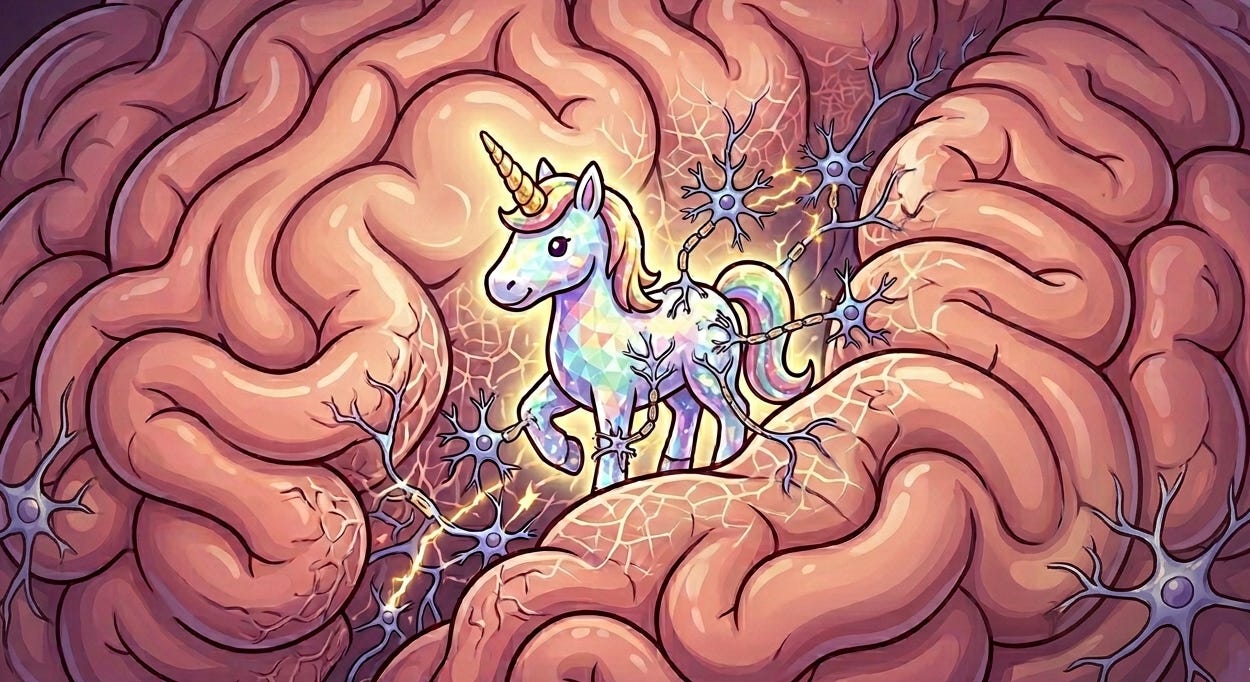
Think about nothing. You simply can’t. As soon as you try to get to nothing, something fills the void. You’re probably trying to imagine pure darkness. But that is still imagining something. Nothing cannot exist, but saying “nothing cannot exist” is itself a paradox.
The problem of other minds: You can't prove that anyone but yourself is conscious. From your perspective, a real conscious being and a perfect projection with no true inner experience would look exactly the same.
2+2=4. But what is “2”? There is no “2” sitting out in the physical world. Numbers are a tool we invented. Useful, but not real. And 2+2=4 only once you grant every assumption. Math itself is broken in many places. Do me a favor… write the smallest possible number. You start 0.000 and keep adding zeros, chasing the 1 at the paradoxical end of infinity. A smallest value can’t exist.
Cause and effect. Imagine you had no memory. You would still see the present moment, “the effect”, exactly as it is. But you could never tie it to a cause, because the cause is already gone. It happened in the past, and the past doesn’t exist anywhere except for your memory and assumptions. In the present moment, the cause doesn’t exist. The only place it still exists is your memory. So cause and effect isn’t something out in the world. It’s your memory linking the present to a nonexistent cause.
If you ask “why” enough times, the entire world falls apart.
Perhaps my biggest pet peeve as a child (and still) is when my mom would tell me, “Because I told you so”, when I asked her “Why?” But I’ll explain below my reasoning for forgiving my mom. Because “because I told you so” might actually be as valid of a response as any.
Here’s an example of how this parent-child interaction typically goes (assuming you have a very patient and philosophical mom):
"Mom, why is the sky blue?"
"Because the air scatters sunlight."
"Why?"
"Because shorter wavelengths scatter more than longer ones."
"Why does that matter?"
"Because light travels as a wave."
"Why?"
"Because of how electric and magnetic fields move through space."
"Why do they do that?"
…At this point, Mom (and every physicist) runs out of road and blurts out:
"Because I told you so! Now eat your fries."

It gets even worse than this for the poor kid: blue doesn't actually exist in the physical world. Most color is just different wavelengths of light. Your brain takes these different wavelengths and gives you the illusion of blue. At no point does any actual blue exist. Magenta doesn't even have a wavelength. Your brain just invents it…
So What Do We Do With This?
My point here is, there’s a pattern. If you take anything and continue asking the question, “Why?”, when asked enough times, you reach the same conclusion: Nothing can be truly known.
But even this itself is a paradox. If I claim that nothing can be known, then I am making a claim with certainty. And one thing is certain: Your certainty cannot be certain, but I cannot be certain about that (and around and around we go on the paradoxical merry-go-round)
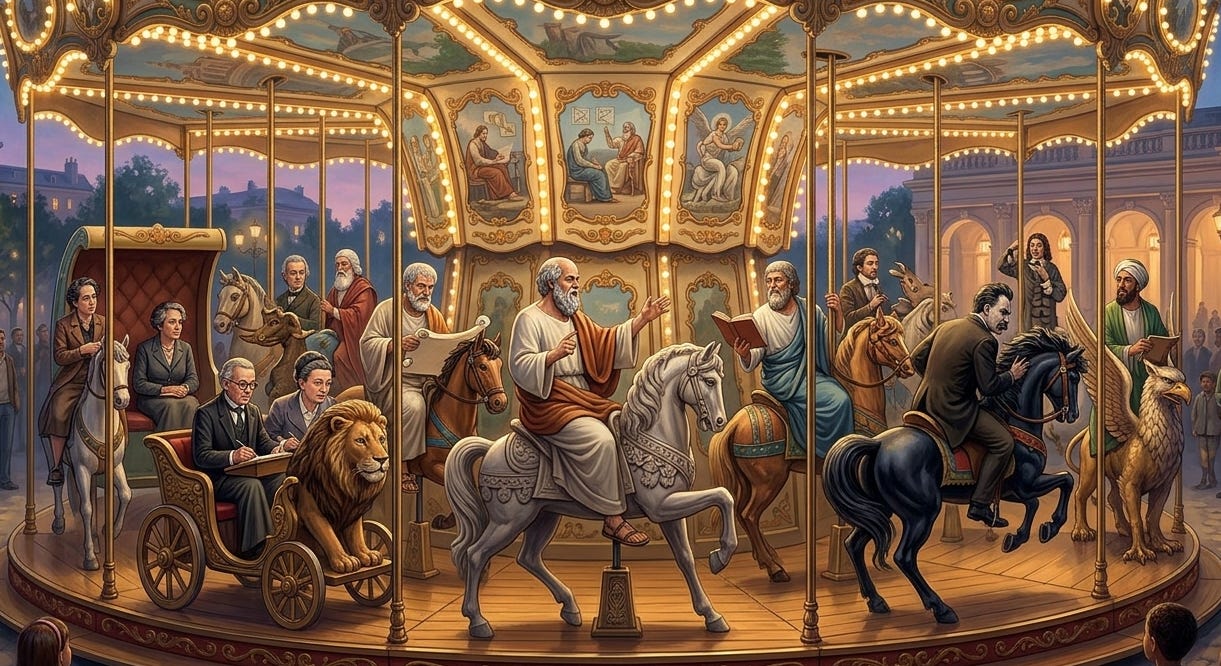
If you are living in a blissfully ignorant bubble and I just burst it, I do offer an empty apology, but I am not sorry. It is best that we try our best to pursue knowledge, even if we might not ever fully reach it.
Just because we cannot reach absolute knowledge does not mean we can’t put more knowledge into things, and more knowledge inside of things is a more contextualized world. I believe that is a good thing.
I’m hoping something actionable can be taken away from this reading, which is to check your ego, your pride, and to not idolize people. This is something our world is in desperate need of.
You don’t know everything. You actually don’t know anything.
Your political candidate isn’t the best political candidate, you just prefer them. The physicist that is “so smart” cannot tell you what gravity is. The neuroscientist can’t explain consciousness. But we’re here and we are conscious.
So, give some grace today to the “other guy”, because they know the same amount of things you know, which is nothing. This world can use a lot more empathy, and a lot less “know-it-alls”. We’re all floating through this rock in space together, knowing nothing. Let’s at least try our best and be kind.
Please share with a friend and subscribe.
I love conversations like this! It’s one of those questions that keep philosophers awake at night! The honest answer is to everything: it depends entirely on the lens you are looking through. In the realm of pure logic and mathematics, absolute truths definitely exist. They're true by definition within their own systems. They don't depend on human opinion, culture, or the state of the universe, however, the catch is always going to be human perception. Some people with a different cognitive worldview tend to overanalyze and over-conceptualize absoluteness which is an error in itself. It gets tricky because while an absolute physical reality exists, our understanding of it is always limited by our senses, but I think we prove by our existence & motivations everyday that absolute truths exist, otherwise everything would be utterly pointless. So we're doing something right.
The most amazing procession of thought on "why" || Richard Feynman. Why. •5.3M views•14 years ago
https://m.youtube.com/watch?v=36GT2zI8lVA&pp =ygULZmV5bm1hbiB3aHk%3D